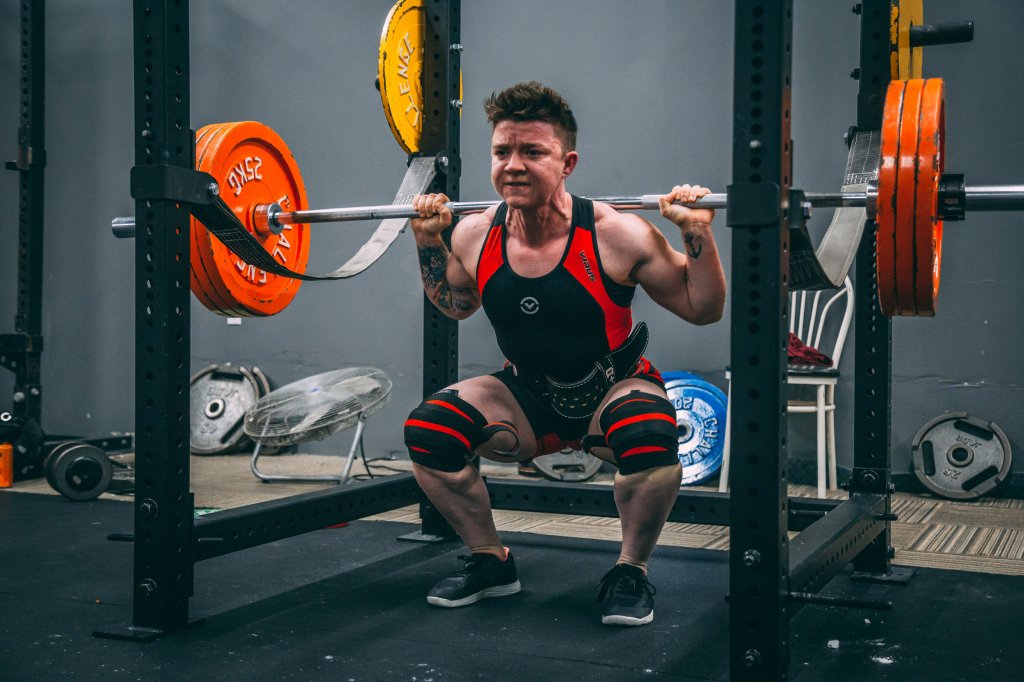
For some people, squatting comes really easily. For others, learning to squat, and doing it safely and effectively, is not a smooth road! If that’s you, and you’re having difficulty figuring out how to fix your squat, then this article is for you.
This is the third in a series looking at the squat. In the first two I looked at the anatomical variations that can affect your squat (such as if you have really long thighs), and the areas of poor mobility that can mess you around. You can find the article about structure here, and the one about mobility here. This time, however, we’re talking about motor control issues.
As a disclaimer, I want to state that these articles are not meant to diagnose or treat any injury or musculoskeletal condition. If you are experiencing pain with your squat, I strongly recommend that you consider getting checked out by a health professional.
Now that’s dealt with, on with the matter at hand! There are times when issues with someone’s squat can be more to do with motor patterning than the shape of their body or mobility issues. What do I mean by that? Well, a motor pattern is the unconscious way you move your body to achieve any given task. How much and in what order you fire your muscles, the way you move around your centre of gravity, where you take the strain of the activity. For example, I bet you have a fixed way of brushing your teeth. You probably do it the same way every time. That’s a motor pattern. Or the way you move your jaw, lips and tongue to effortlessly produce intelligible words when you speak. That’s another motor pattern. We use motor patterns for everything we do. When we’re first learning a motor pattern we have to really concentrate and work at it. Over time it becomes easier and more instinctive. That’s when the motor pattern is established.
Sometimes we develop motor patterns that are inefficient. They don’t work so well, or put unnecessary strain on certain parts of our body. These habits become ingrained and we don’t even think about them, and they can lead to pain and injury. When that happens you have to relearn the movement. Sometimes from the ground up.
A lot of the fixes outlined below are meant to do that – help you relearn a better way to squat.
“First move well, then move often”
Now, I believe in paying dues, so I want to mention that a lot of what’s here is stuff I’ve picked up from the Functional Movement Systems group, founded by Gray Cook, Kyle Kiesel, Greg Rose and Lee Burton. They discuss some awesome ways to address movement dysfunction! Quite a number of others have taken their material and applied it very well. One such example is Dr Zach Long from The Barbell Physio, who has written some excellent articles on this topic.
A lot of the fixes in this article are based on what these guys call Reactive Neuromuscular Training (or RNT). It revolves around putting some stimulus into the system to actually make the existing problem worse. They “feed” the problem! When you do this, most people will reflexly work against that input and self-correct. Do it often enough, and a person relearns the skill with a more efficient motor pattern. Pretty simple, huh? Alright, let’s get on with it.
Because these exercises are aimed at improving your motor patterns, it’s good to check to see what’s changed. That means squat before and afterwards, and check what’s different. You may feel the difference – for example, more balance, greater ease, improved positioning. It may also be worth videoing your squat, so you have an objective measure before and after your rehab exercises. When you video your squat, it also gives you something to compare to down the track. Video your squat from the angle that will best show what you’re trying to fix – for forward lean, video from the side, for lateral hip translation or knee valgus, video from the front.
Another very important point is how you work these exercises. They are meant to build better movement patterns, and to do that you have to drill the better movement. Now, I’ve given rough ideas on rep ranges for all the exercises, but these are meant as guides only. If you are performing one of these moves and you can’t move well (your forward lean or hip translation gets worse with the exercise), then you must STOP. Immediately! If you don’t, you will drill poor movement habits, and things will only get worse. If you can only perform 3 or 4 reps with good form, then it starts to degenerate, then only perform 3 or 4 reps. Trust me, it will get better with time and patience. If you can’t even perform a single rep, then you may need a less demanding progression of the exercise before you move on to the ones outlined in this article. (It’s also possible that there are other movement faults that need to be addressed first, and for that you may need the help of a professional.)
So, on to the fixes!
1. Posterior Chain Activation:
The first issue I want to look at is poor posterior chain activation. That means using your glutes and hammies when you squat. It also means having appropriate activation of your spinal muscles to stabilise your back. If you have poor posterior chain activation in your squat you might find that you tend to lean forward at the bottom of the squat. You might also find it’s hard to keep your spine straight. You will probably also be what’s called “quad dominant”. That means you use your quadriceps (the big muscles at the front of your thighs) to produce the power in your squat, rather than having a more appropriate and efficient balance between your glutes and quads. This can result in taking a lot more strain through your knees than necessary, and if you are squatting heavy then eventually this can lead to knee pain.
One of the best ways to activate your posterior chain is to hold a weight in front of you. One way to do this is to perform a goblet squat, which involves holding a kettle bell or dumbbell in front of your chest while squatting. Another approach is to squat while holding a light dumbbell out in front with straight arms. The placement of the weight in front of your body’s centre of gravity will force you to use your glutes more while squatting, You’ll also feel your spinal muscles working harder. Finally, it also allows you to squat with your torso more upright. In the video below you’ll see the progressive change in how upright your torso is from a simple air squat, through a goblet squat, to a straight-arm dumbbell squat. What some people find is that they can squat deeper when doing these variations. You might also find that you feel more upright after performing a few reps. Goblet squats and straight-arm dumbbell squats can be really useful to include in your warm-up. Do 2-3 sets of 10-12 reps, with a moderate weight for the goblet squats and a light weight for the dumbbell squats. You’re not trying to gas yourself out, it should be a warm-up.
 Sam bettison